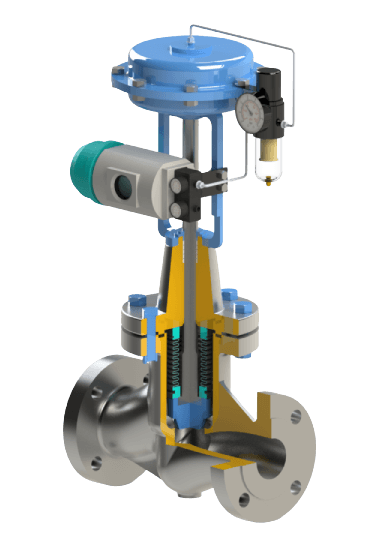
A bellow seal globe gate control valve combines the leakage-control advantages of a metal bellows seal with valve configurations designed for isolation, throttling or automated process regulation. In conventional valves, the stem normally passes through the valve bonnet and requires packing to control leakage around the moving stem. For applications involving hazardous chemicals, toxic fluids, steam, high-temperature media or environmentally sensitive processes, leakage through the stem area can become an important operational and safety concern. Bellow Seal Valves use a welded or mechanically formed metal bellows around the stem to create an additional sealing barrier. Depending on the required function, this construction can be incorporated into Globe, Gate or Control Valve designs.
What Is a Bellow Seal Valve?
A Bellow Seal Valve is an industrial valve designed to minimize external leakage through the valve stem. The metal bellows is connected between the stem and bonnet area and flexes as the stem moves.
Unlike conventional packed valves, where the packing must accommodate continuous stem movement, the bellows provides a sealed metallic barrier. The packing may still be included as a secondary safety arrangement depending on the valve design.
The bellows must withstand repeated movement, pressure, temperature and process conditions. Therefore, bellows material, wall thickness, number of convolutions, welding quality and fatigue performance are important engineering considerations.
Working Principle of a Bellow Seal Globe Valve
A Bellow Seal Globe Valve uses a linear-moving stem and a closure element that moves toward or away from the valve seat. When the handwheel or actuator moves the stem, the bellows expands or contracts while maintaining the sealed barrier around the stem.
Globe valves are commonly selected where controlled flow regulation or reliable isolation is required. Their internal flow path generally creates greater pressure loss than a straight-through gate valve, but the geometry makes them suitable for throttling applications.
The principal sealing arrangement includes the process pressure boundary, valve seat and the metal bellows surrounding the stem. Properly engineered construction helps prevent process fluid from reaching the external stem area.
Working Principle of a Bellow Seal Gate Valve
A Bellow Seal Gate Valve is primarily intended for on/off isolation. The gate moves vertically to open or close the flow passage.
When fully open, a gate valve provides a relatively unobstructed flow path and is therefore suitable for applications where low pressure drop is important. It is generally not recommended for continuous throttling because partially open operation can result in undesirable flow conditions and seat damage.
The bellows moves with the stem while maintaining a sealed barrier. This makes the configuration useful in services where external stem emissions must be minimized during normal operation.
Working Principle of a Bellow Seal Control Valve
A Bellow Seal Control Valve combines a metal bellows stem-sealing arrangement with an automatically actuated valve designed for process regulation.
A control valve continuously adjusts the flow according to a signal from a process control system. Depending on the application, the actuator can be pneumatic, electric or another suitable configuration. A positioner may be used to improve valve positioning accuracy.
The bellows protects the stem area while the internal trim controls the process flow. This arrangement can be useful where automated control and reduced external leakage are both important.
Why Metal Bellows Are Important
The metal bellows is the central component of the sealing arrangement. It is subjected to repeated flexing whenever the valve operates.
For this reason, bellows design should consider:
- Operating pressure
- Temperature range
- Number of operating cycles
- Bellows material
- Corrosion resistance
- Welding quality
- Stroke length
- Fatigue resistance
- Process compatibility
A properly selected bellows helps maintain sealing performance over the intended operating life of the valve.
Applications of Bellow Seal Valves
Bellow Seal Globe, Gate and Control Valves are commonly considered for demanding industrial services such as chemical processing, petrochemical plants, oil and gas facilities, pharmaceutical production, power generation and steam systems.
They can be particularly useful when the process medium is hazardous, toxic, volatile or environmentally sensitive. Steam and thermal services may also require careful stem sealing because external leakage can create personnel and energy-efficiency concerns.
Importance of Valve Testing
Testing is an essential part of industrial valve quality control. Depending on the valve specification and service requirement, inspection can include pressure testing, seat leakage testing, dimensional inspection, material verification and fugitive-emission or helium leak testing.
FRETURE TECHNO PVT. LTD. develops industrial valve solutions for demanding process applications, with emphasis on safety, reliability and controlled leakage performance. Its valve engineering approach includes applicable international standards and inspection requirements based on service conditions.
Conclusion
A bellow seal Globe/Gate control valve is not a single valve configuration but a group of valve solutions using metal bellows technology for improved stem sealing. Globe Valves are commonly selected for throttling and regulation, Gate Valves for isolation and Control Valves for automated process regulation. Selecting the correct design requires consideration of pressure, temperature, media, operating cycles, materials, actuation and applicable standards. In critical industrial applications, proper valve engineering and testing are essential because reliable containment is directly connected to plant safety, equipment protection and environmental performance.